
AI Acceptable Use Policy: How to Write One for Your Business
By Abdul Rehman, Founder of Inovetics · · 9 min read
This guide is for founders, operations leads and managers at small and mid-sized businesses whose teams already use tools like ChatGPT, Copilot, Gemini or Claude. The bottom line: if people in your business use AI, you need a short written policy that says which tools are allowed, what information stays out of them and when a human must check the result. You can write a sensible first version in an afternoon.
What is an AI acceptable use policy?
An AI acceptable use policy is an internal document that sets the rules for how employees, contractors and other people working for you may use artificial intelligence tools. It covers four things: which tools are approved, what data may be entered, how output must be checked and labelled, and who is accountable when something goes wrong.
It is not a strategy document. Your AI strategy decides where AI should create value; the acceptable use policy keeps everyday use safe while that strategy develops. If you have not yet worked out where AI fits, our guide on what AI consulting is explains how businesses usually tackle that question.
Why does your business need an AI policy now?
Most businesses do not get to decide whether staff use AI. People already paste emails, proposals, spreadsheets and meeting notes into free chat tools because it saves them time. Without rules, you cannot know whether customer details, pricing or confidential contracts have left your systems.
There are three practical reasons to act now:
- Data protection. Entering personal data into an AI tool is still processing personal data. Your obligations under UK GDPR, EU GDPR or local privacy law do not disappear because the tool is new.
- Quality and liability. AI tools can produce confident but wrong answers. If an unchecked AI-written quote, contract clause or support reply reaches a customer, your business owns the mistake.
- Regulation in Europe. If you operate in the EU, Article 4 of the EU AI Act on AI literacy has applied since 2 February 2025. The European Commission's AI literacy Q&A says it requires providers and deployers of AI systems to take measures to support the AI literacy of their staff and others using AI on their behalf, with national supervision and enforcement from 2 August 2026.
As of November 2026, the Commission's Q&A also notes that Article 4 has been amended by the Digital Omnibus on AI: AI literacy remains an obligation, but no specific or "sufficient" level is mandated. The Q&A is clear that no certificate is needed and that organisations can keep an internal record of training. In other words, regulators are looking for sensible, proportionate effort, which is exactly what a short policy and a training log provide. This is general information, not legal advice, so check your own position with a qualified adviser.
Should you ban AI tools or approve them?
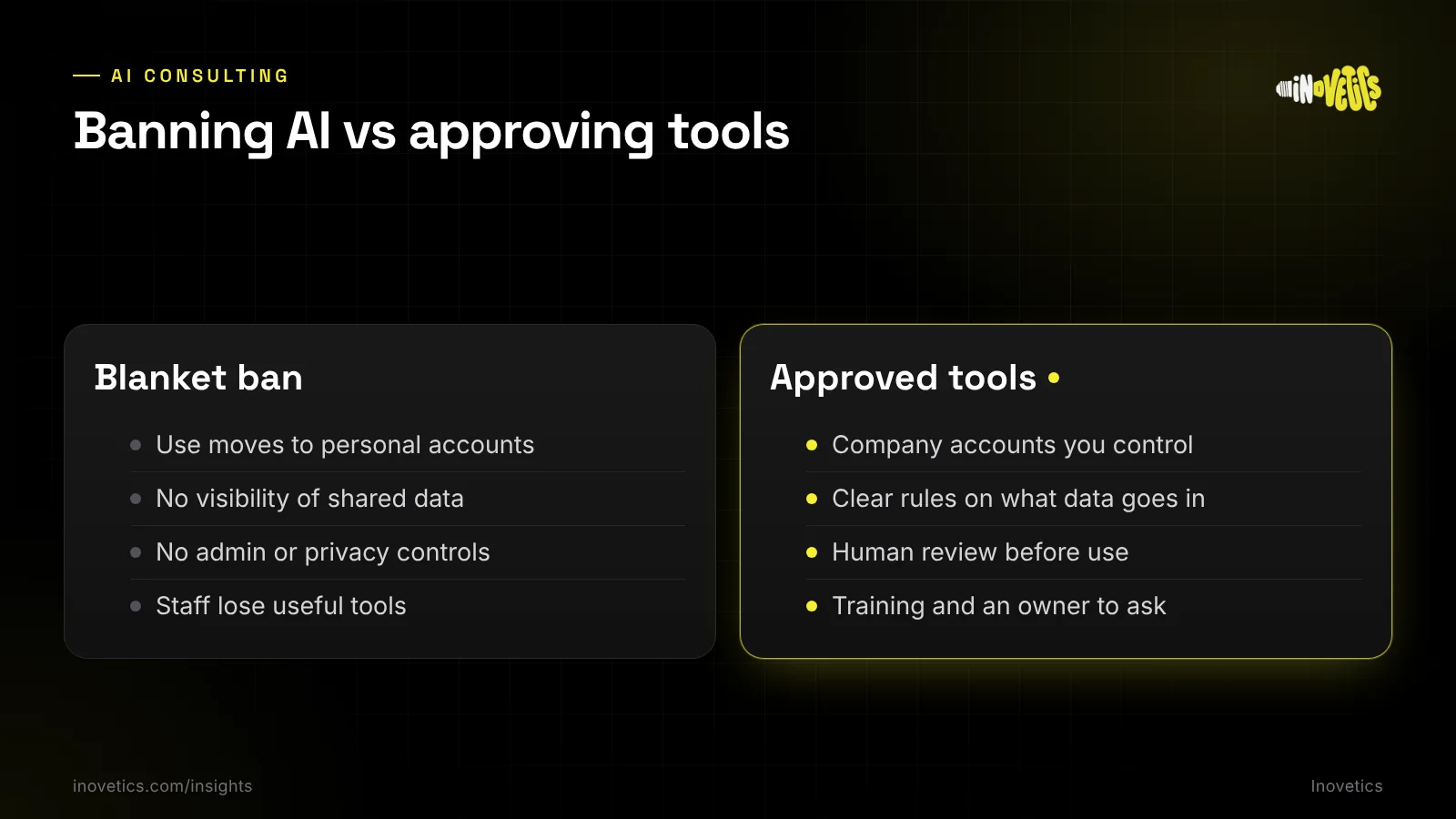
Banning AI feels safe, but it usually just moves the risk out of sight. Staff who find AI useful keep using it on personal phones and accounts, where you have no contract with the provider, no admin controls and no record of what was shared. The UK data protection regulator, the ICO, takes the approve-and-control route for its own staff: its Internal AI Use Policy says staff should only use AI that has been approved for internal use, and that AI outputs should be reviewed by a human.
For most small and mid-sized businesses, the better approach is to approve a short list of business-grade tools, turn on the settings that stop your data being used for training where the provider offers them, and make the rules about data very clear.
What should an AI acceptable use policy include?
Keep the policy to two or three pages. These eight sections cover what a small or mid-sized business needs:
| Section | What it says | Example rule |
|---|---|---|
| 1. Purpose and scope | Who the policy applies to and which activities it covers | Applies to all employees, contractors and freelancers using AI for company work |
| 2. Approved tools | The specific tools and account types allowed | Use only company accounts on the approved list; personal accounts are not allowed for work data |
| 3. Data rules | What may and may not be entered, using traffic-light categories | Never enter customer personal data, passwords or unreleased financials into any AI tool unless the use case has been approved |
| 4. Human review | Which outputs must be checked before use | Anything sent to a customer, published or used in a decision is checked by a named person |
| 5. Transparency | When to tell people AI was involved | Customers are told when they are talking to an AI assistant |
| 6. Prohibited uses | Things AI must never be used for | No AI-only decisions on hiring, firing, credit or pricing for individuals; no legal or medical advice from AI |
| 7. New tools and use cases | How staff request something new | Submit a short request; the policy owner replies within five working days |
| 8. Training, incidents and review | Training expectations, how to report mistakes, review date | Report any accidental data entry the same day; policy reviewed every 12 months |
The ICO's own policy is a useful benchmark here. Alongside approved tools and human review, it asks staff to annotate chatbot output as AI-generated, says advice that needs a licensed professional should come from that professional rather than AI, and expects senior leaders to give all staff access to general AI literacy training. You will not need every control a regulator uses, but its structure shows what a serious, readable policy looks like.
How do you set data rules people will actually follow?
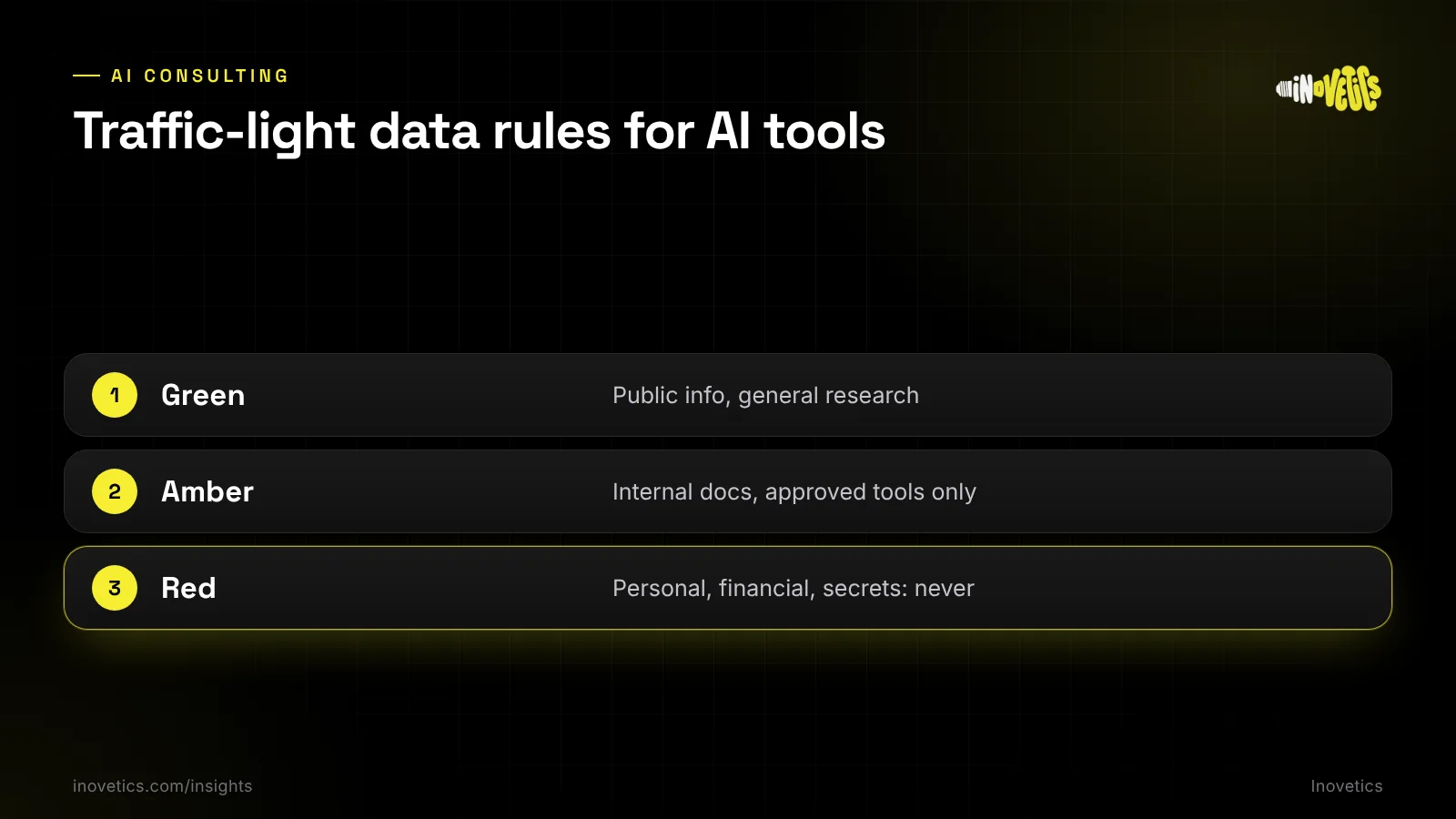
Data rules are where most policies fail. "Do not enter confidential information" is too vague; staff will interpret it differently. A traffic-light system with examples from your own business works far better:
- Green (fine in any approved tool): public information, published marketing copy, general research questions, anonymised examples.
- Amber (approved business tools only, with care): internal documents, draft proposals, non-sensitive operational data, meeting notes with names removed.
- Red (never, unless a specific use case has been approved): customer and employee personal data, health or financial details, passwords and API keys, unreleased financial results, information covered by a client confidentiality agreement.
Add three or four real examples from your own work under each colour. "A customer's order history with their name and address" is red; "our standard returns policy" is green. Concrete examples answer most questions before anyone has to ask.
How do you roll out the policy and train your team?
A policy nobody reads protects nobody. Roll it out in five steps:
- Find out what is already in use. Ask teams, without blame, which AI tools they use and for what. This tells you which tools to approve first.
- Name an owner. One person, often operations or IT, approves tools, answers questions and keeps the policy current.
- Write the policy and a one-page summary. The summary lists approved tools, the traffic-light data rules and who to ask.
- Train everyone in a short session. Cover how the approved tools work, why AI output can be wrong, the data rules and how to report a mistake. Keep a simple record of who attended and when.
- Review after 90 days, then yearly. Look at tool requests and incidents, update the approved list and adjust rules that were unclear.
If you want a recognised structure for thinking about AI risk as you grow, the NIST AI Risk Management Framework is a free, voluntary framework released in January 2023, with a Generative AI Profile added in July 2024. It is designed for organisations of any size and is a sensible reference once you move from everyday tool use into building AI into your own processes.
Common mistakes to avoid
- Copying a large company's policy. A 20-page document written for a bank will not be read by a 15-person team. Write for your business.
- Listing rules without tools. If you ban free tools but approve nothing, people will ignore the policy.
- Forgetting contractors. Freelancers and agencies handling your data should follow the same rules. The Commission's AI literacy Q&A also points out that people acting on your behalf, such as contractors, fall within scope.
- Treating it as a one-off. AI tools change quickly. A policy with an out-of-date approved list loses credibility fast.
- Ignoring automation and chatbots. Once AI is built into your workflows or customer service, the policy needs a section on how those systems are approved, tested and monitored, not just on individual chat use.
From policy to practical AI
An acceptable use policy is a foundation, not the finish line. Once your team uses AI safely, the next step is usually to move the most valuable uses out of copy-and-paste chat and into proper, controlled workflows. Our step-by-step guide to implementing AI in your business and our overview of AI automation for small businesses show what that looks like.
Inovetics helps businesses set up the governance basics, including approved tools, data rules and human review points, as part of our AI consulting work, and then builds and connects the systems through AI integration. If you would like a second opinion on your draft policy or on where AI could help next, book a free 30-minute consultation or try the AI Opportunity Finder.
Frequently asked questions
What is an AI acceptable use policy?
It is a short internal document that sets the rules for how employees and contractors may use AI tools at work: which tools are approved, what data can and cannot be entered, when output must be checked by a person, and who is responsible for questions and incidents.
Should a small business ban ChatGPT and other AI tools?
A total ban rarely works on its own, because staff who find AI useful tend to keep using it on personal accounts where you have no visibility. Approving a small set of business-grade tools with clear data rules usually gives you more control than a ban.
Does the EU AI Act require an AI policy?
The AI Act does not require a document called an AI policy. Article 4 does require providers and deployers of AI systems to take measures to support the AI literacy of staff using AI on their behalf, and a written policy plus a record of training is a practical way to show you have done that. Ask a qualified adviser about your specific obligations.
How long should an AI acceptable use policy be?
For most small and mid-sized businesses, two to three pages is enough. A one-page summary of the key rules, pinned where people work, gets read far more often than a long legal document.
How often should we update our AI policy?
Review it at least once a year, and also whenever you approve a new AI tool, start using AI with customer data or a regulation that affects you changes.
Sources
- AI Literacy - Questions & Answers, European Commission
- Internal AI Use Policy, Information Commissioner's Office (ICO)
- AI Risk Management Framework, National Institute of Standards and Technology (NIST)
Related services